

Foundation Wall Repair in Inman, NE
Foundation wall repair in Inman, NE starts with a string line. Under 2 inches of bow means carbon fiber, past that means anchors. Number in writing.
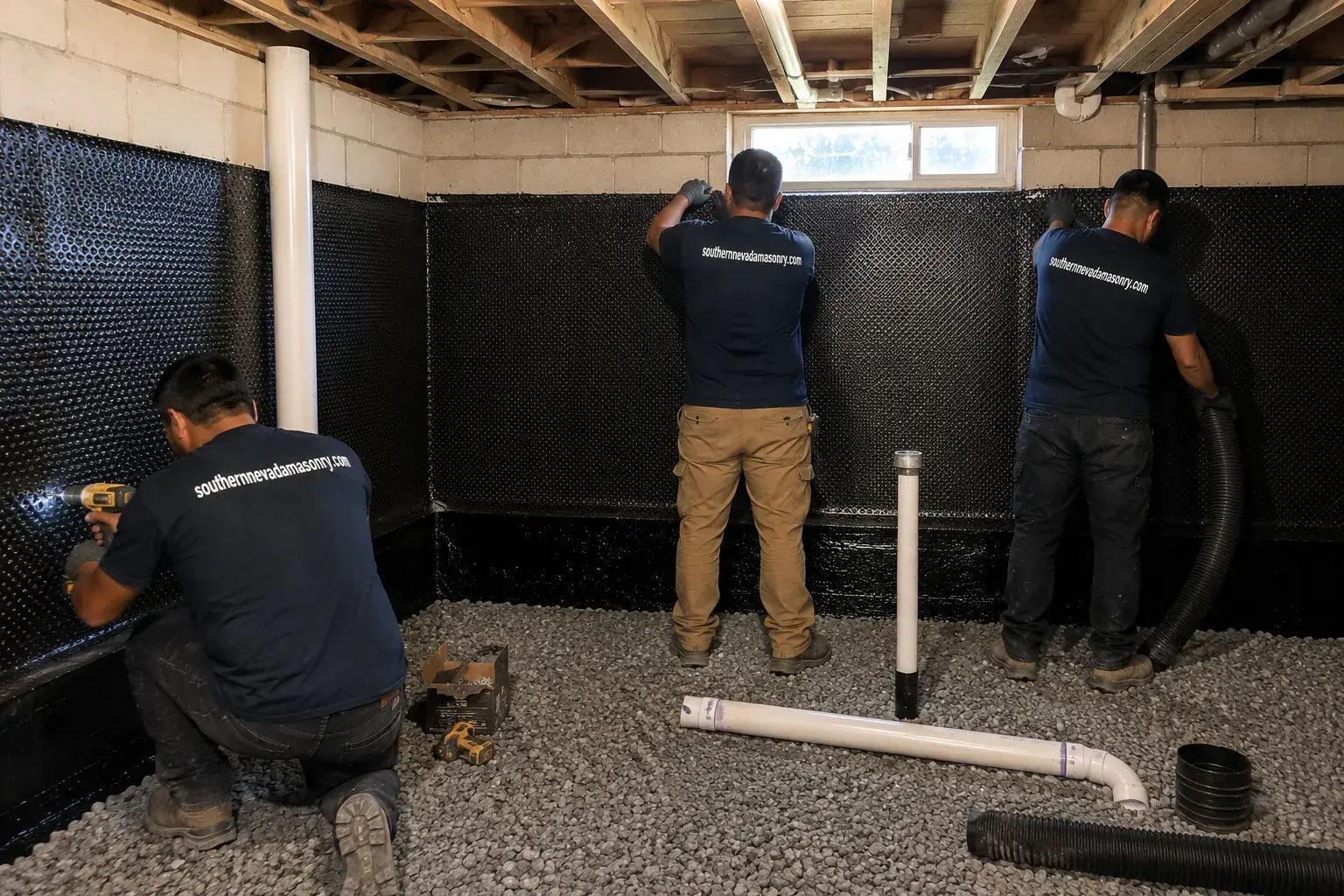

Best Foundation Wall Repair in Inman, NE
One number decides this entire job. How far the wall has moved inward, measured in inches, from where it should be. Everything else, method and price and how long it takes, follows from that measurement, and most people searching foundation wall repair near me have never been shown it.
Measuring it is simple. A string line is pulled tight from the top corner of the wall to the bottom corner, and the gap at the widest point is the deflection.
Under two inches, carbon fiber straps are usually the answer. Woven carbon fabric is bonded to the wall with structural epoxy, running the full height from the footing to the sill plate, spaced every four to five feet. It is about a fiftieth of an inch thick, so it can be painted over and disappears behind a finished wall.
Straps hold the wall where it is. They do not push it back.
That is the part people misunderstand. Carbon fiber freezes the current shape permanently, which is fine if you can live with the bow you have. If you want the wall moved back toward straight, you need wall anchors.
Anchors work differently. A steel rod runs through the wall and out to a plate buried in solid soil in your yard, with a plate on the inside that gets tightened. Over months, the crew comes back and turns it a little at a time, slowly pulling the wall back. That needs yard space to bury the plate, so utility lines or a tight lot can rule it out.
Steel I beams are the third route. They bolt to the floor and the floor joists above, standing vertically against the wall every four to five feet, and they stick four to six inches into the room. No digging outside, and some systems can be adjusted over time.
Then there is a specific case where straps are wrong no matter what the number says.
If the wall is not curving in the middle but sliding inward at the bottom where it meets the floor, that is shearing, not bowing. Carbon fiber cannot stop a wall from sliding. That needs steel bracing that mechanically blocks the movement.
Past two inches, the geometry has changed enough that straps lose their grip on the problem, and anchors or beams take over. Past about half the wall thickness, an eight inch wall bowed more than four inches, the wall generally comes out and gets rebuilt.
Money follows those thresholds closely. Carbon fiber straps run $350 to $1,000 each installed, so a twenty foot wall lands somewhere around $1,700 to $5,000. Wall anchors run $400 to $700 apiece. Straightening a wall properly runs $6,700 to $11,000, and rebuilding runs higher still.
Which is the real argument for measuring today rather than next spring. A wall bowed an inch is a carbon fiber job. The same wall after a few more wet springs is a steel job at three times the price, and nothing changed except time.
Under the residential code, foundation walls have to resist the soil pressure pushing on them. A bowing wall has already failed that job, which is why this is one of the few foundation problems that can go from ugly to dangerous quickly.
The cause matters as much as the fix. Soil pushes hardest when it is saturated, so gutters, downspout extensions, and grading that carries water away are part of any honest quote for foundation wall repair near me. Bracing a wall while leaving the water against it is half a repair.
Ask for the deflection in writing, dated, before and after. Without a starting number nobody can prove anything held.
We have measured and braced walls across Inman, NE for 21 years, and we bring a string line to every visit. If you searched foundation wall repair near me and nobody has given you a number in inches yet, call (833) 769-2615 and we will start there.